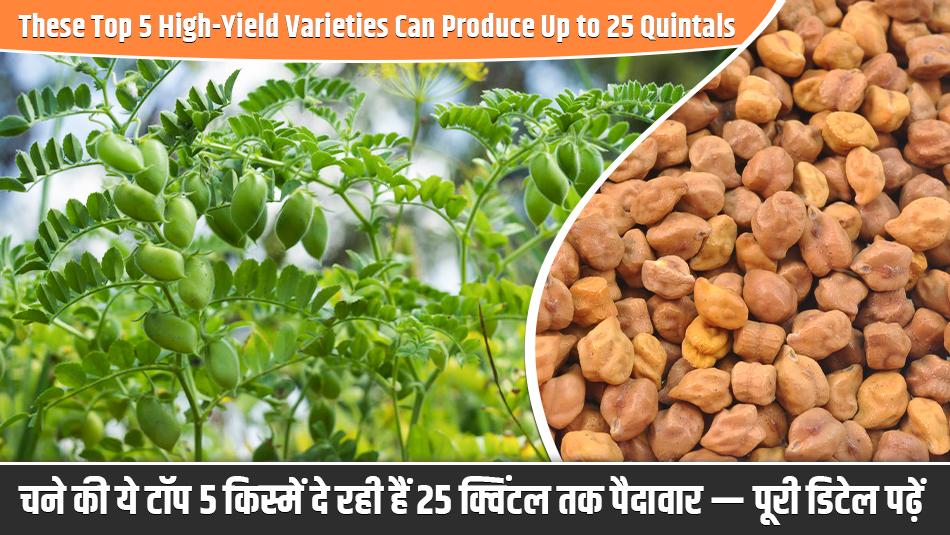

With the arrival of the Rabi season, farmers across the country begin preparations for chickpea cultivation—one of the most important crops of this period. Chickpea is not only a low-cost, high-income crop, but its yield directly influences a farmer’s overall earnings. This makes choosing the right variety extremely crucial.
To guide farmers in selecting the best seeds for their soil and climate, the Bihar State Seed Corporation has released details of five improved and high-yielding chickpea varieties. These varieties are not only capable of producing 20 to 25 quintals per hectare, but also show strong resistance against major diseases. Adopting these varieties can significantly boost production and profitability.
GG-4 is a special chickpea variety developed in the year 2000. Sown mainly between November and December, it matures in 120–130 days.
Sabour Chana-1 is an improved desi chickpea variety released in 2020.
This variety also has a very low risk of frost damage, making it suitable for colder regions.
GNG-2207, also known as Awadh Chana, was developed in 2018 at the Agricultural Research Centre in Sri Ganganagar, Rajasthan.
This variety performs well in humid and subtropical agro-climatic zones.
Developed in 2015, RBG-202 is a compact and improved chickpea variety.
It is ideal for regions prone to sudden temperature drops or windy conditions.
BG-3043, commonly known as Pusa 3043, was introduced by the Indian Agricultural Research Institute (IARI) in 2018.
This variety is known for its stable performance even under moisture stress.
For farmers planning to cultivate chickpea this Rabi season, these five varieties offer excellent potential for bumper yields. Their strong disease resistance and ability to adapt to fluctuating weather conditions make them highly dependable choices. By selecting the right variety, farmers can significantly increase both their productivity and profits.
Latest Update