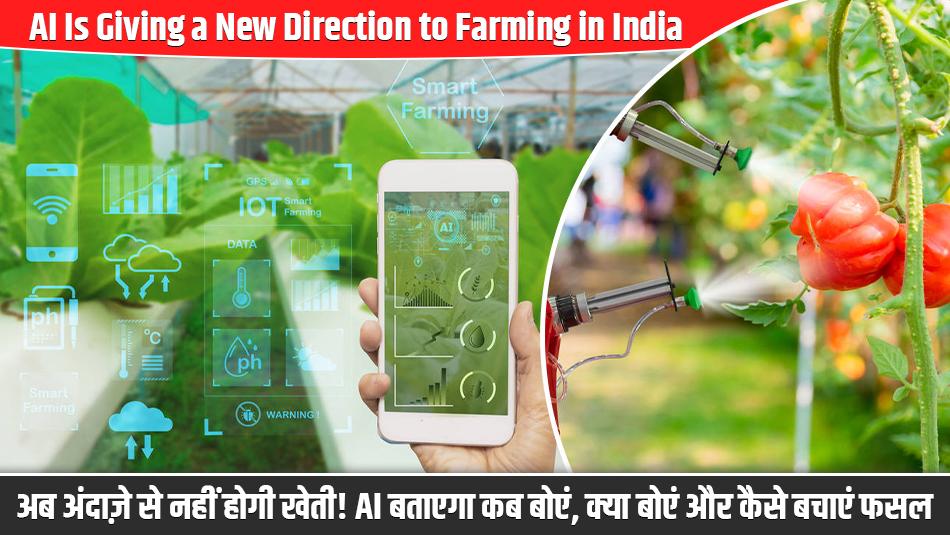

To modernize agriculture and reduce risks for farmers, the Indian government is rapidly adopting Artificial Intelligence (AI) technologies. According to information presented in Parliament, AI-based systems are now helping farmers receive more accurate and timely information related to weather forecasts, sowing decisions, pest management, crop monitoring, and government schemes.
As a result, farmers are making better-informed decisions, reducing economic risks, and improving overall farm productivity.
The government informed the Rajya Sabha that during Kharif 2025, an AI-based monsoon forecasting pilot project was implemented across 13 states. Developed in collaboration with the Development Innovation Lab–India, the project used an open-source blended model combining:
This advanced system predicts the local onset of the monsoon, which is crucial for farmers while planning sowing, land preparation, and input usage.
The AI-based monsoon advisories were delivered through the mKisan portal via SMS to over 3.88 crore farmers across the country. Messages were sent in five regional languages — Hindi, Odia, Marathi, Bengali, and Punjabi — ensuring better understanding and timely action at the grassroots level.
Post-forecast surveys conducted in Madhya Pradesh and Bihar revealed significant behavioral changes among farmers. Around 31% to 52% of farmers modified their sowing and land preparation decisions based on AI-generated advisories.
Many farmers also adjusted crop selection, seed quantity, and fertilizer use, demonstrating that AI-based information is having a direct and measurable impact at the field level.
AI is not limited to weather forecasting alone. The government highlighted the role of “Kisan e-Mitra”, a voice-based AI chatbot that acts as a digital assistant for farmers.
It provides instant answers to queries related to:
Available in 11 Indian languages, the platform has already resolved over 9.3 million farmer queries.
With climate change increasing the risk of pest attacks, the government has introduced an AI and Machine Learning–based National Pest Surveillance System.
Using this system, farmers and agriculture officers can:
Currently, the system covers 66 crops and over 432 pest species, strengthening early warning and pest control efforts.
AI-driven satellite data and field image analysis are being used to assess:
This data supports better policy planning, crop risk management, and faster decision-making during disasters.
As per information shared in the Lok Sabha, AI is also improving the agricultural supply chain. AI-based systems are helping optimize:
These improvements aim to ensure that farmers receive fair and better prices for their produce.
The government believes that AI will play a key role in increasing farmers’ income in the coming years. Real-time insights on weather, soil, pests, and crops will make farming more scientific, sustainable, and resilient.
This technological shift is expected to boost productivity while strengthening farmers’ trust in modern agricultural solutions.
Latest Update