
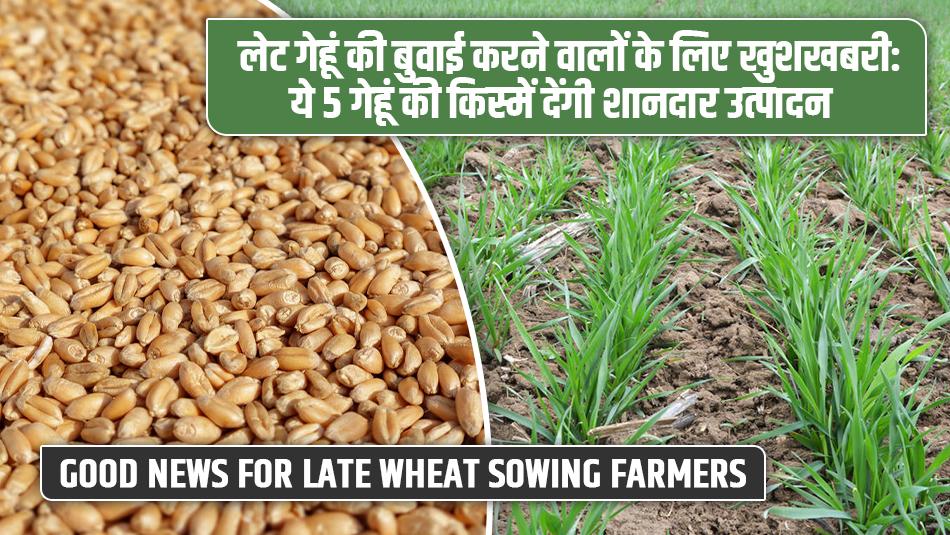

If you are preparing to sow wheat after harvesting vegetables and the sowing has been delayed, there is no need to worry. Many farmers believe that late sowing always results in low yields, but the truth is that with the right variety selection, even late-sown wheat can deliver excellent returns.
Agricultural scientists have developed special wheat varieties for late sowing that mature in a shorter time, tolerate higher temperatures, and still provide good production. These varieties are especially beneficial for farmers sowing wheat till the end of December. In this article, we introduce 5 best wheat varieties that perform exceptionally well even under delayed sowing conditions.
Sowing wheat up to the last week of December is considered late sowing. Under such conditions, normal varieties often fail to give expected yields. However, late-sown wheat varieties are designed to mature quickly and produce stable yields. These varieties are particularly useful for farmers growing wheat after potato, onion, or vegetable crops.
Pusa Ojaswi HI-1650 is a bio-fortified wheat variety rich in zinc, iron, and protein. It performs well even with limited irrigation and is suitable for chapati, bread, and biscuits. This variety matures in about 115–120 days and can yield 14–16 quintals per bigha. Its long, shiny, amber-colored grains are its key identity.
This variety is known for early maturity and high heat tolerance, making it ideal for delayed sowing. Pusa Ahilya HI-1634 matures in about 105–110 days and produces 12–15 quintals per bigha. Due to its excellent chapati and biscuit quality, it is gaining popularity across India.
HI 1544 is popular in the market due to its round and shiny grains, which fetch better prices. It matures in 110–115 days and gives a yield of 10–13 quintals per bigha. Because of its taste and nutritional quality, it is considered a Sharbati-type wheat, making it a profitable option for farmers.
GW-513 is an improved variety with bright and attractive grains. It has good tillering capacity, allowing farmers to achieve higher yields even with a lower seed rate. Depending on the region, it matures in 105–117 days and yields 12–15 quintals per bigha. Its chapati and biscuit quality is considered very good.
According to agricultural experts, varieties such as PBW 906, HD 2932, Pusa 111, DL 788-2 (Vidisha), JW 1202, JW 1203, MP 3336, and Raj 4238 are also suitable for late sowing. These varieties should be sown by 31 December to ensure proper crop growth and favorable temperature conditions.
Immediately after sowing, making cross drains at 15–20 meter intervals is beneficial. Irrigation through these channels ensures uniform water distribution and stronger root development. Under late sowing conditions, irrigation should be given at 17–18 day intervals, and about four irrigations are generally sufficient.
For late-sown wheat, agricultural scientists recommend applying Nitrogen, Phosphorus, and Potash at 100:50:25 kg per hectare. Half of the nitrogen and the full dose of phosphorus and potash should be mixed into the soil before sowing. The remaining nitrogen should be applied with the first irrigation. Ensure that urea is applied only in areas where irrigation can be done on the same day.
For farmers sowing wheat after potato or onion till the end of December, choosing the right variety and following scientific farming practices is crucial. The late-sown wheat varieties mentioned above can mature quickly and provide good yields, helping increase farm income. With proper management, late sowing can also become a profitable farming decision.
Latest Update