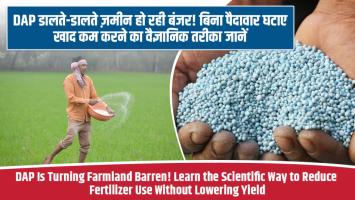
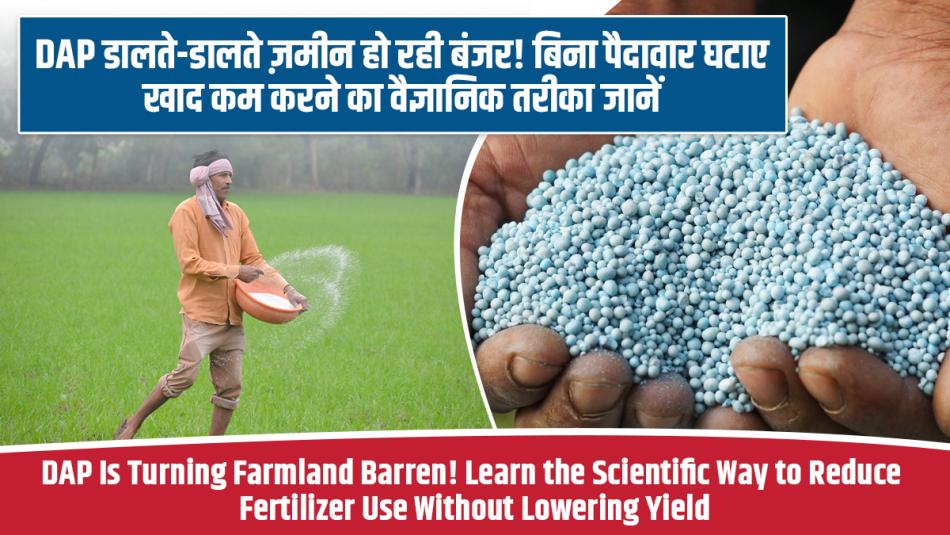

Excessive and continuous use of chemical fertilizers has become a serious challenge for farmers. A recent survey conducted by the central government revealed that the consumption of urea and DAP (Di-Ammonium Phosphate) has been steadily increasing over the past few years. This trend is directly affecting soil health. Experts warn that excessive use of DAP is reducing soil fertility, and in many regions the land is slowly turning barren.
The biggest question before farmers today is: Can DAP use be reduced without affecting crop yield?
According to agricultural experts, the answer is yes—by adopting the right techniques and biological alternatives.
DAP is a phosphate fertilizer that supplies phosphorus to crops. The problem is that plants are able to utilize only about 20% of the DAP applied. The remaining portion gets fixed in the soil and gradually increases the soil’s pH level.
As the pH rises, essential nutrients such as zinc, iron, and calcium become unavailable to plants. As a result, farmers are forced to apply more fertilizer every year, increasing costs and further degrading soil quality.
According to agricultural experts, by adopting certain biological and natural practices, DAP consumption can be reduced by 35–40% without compromising yield.
Applying a solution of NPK consortium and PSB (Phosphorus Solubilizing Bacteria) helps make the phosphorus already present in the soil easily available to plants. This significantly reduces the need for additional DAP.
Mineral calcium borate is a natural product containing six essential nutrients. It helps convert phosphorus into a form easily absorbed by plants. The best time to apply it is at sowing, and it can be used up to the first irrigation. Its use after that is generally not recommended.
Endomycorrhiza is a beneficial fungus that attaches itself to plant roots and increases root spread. This improves the availability of nutrients like phosphorus and zinc and helps retain soil moisture. It is especially beneficial for light and weak soils.
Expert advice: If mineral calcium borate and endomycorrhiza are applied at the time of sowing, DAP usage can be reduced by 35–40%.
Agricultural scientists explain that phosphate-based fertilizers increase soil pH. As pH rises, crops require more nutrients. To meet this demand, farmers apply even more fertilizer, worsening the problem.
Eventually, a stage comes when no matter how much fertilizer is applied, plants fail to absorb nutrients—and the land begins to turn barren.
Experts caution that in areas where the soil is light and the pH level is above 8, SSP (Single Super Phosphate) should not be used at all. SSP requires higher quantities, and to maintain the same yield every year, its dose must be increased—leading to negative long-term effects on soil health.
Continuous use of DAP is damaging soil fertility in the long run. However, if farmers adopt biological alternatives, microbial cultures, and natural nutrient sources in time, they can not only reduce DAP consumption but also prevent their land from becoming barren.
For sustainable and profitable farming, it has become essential to move beyond excessive chemical fertilizer use and adopt a balanced, scientific approach.
Latest Update