Why Onion and Garlic Yields Drop: The Science of Soil and Nutrients

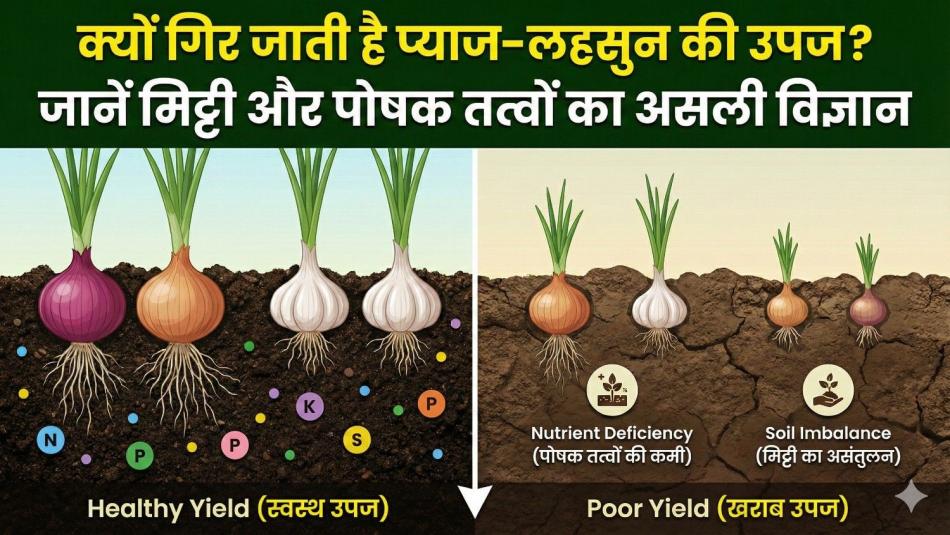
Why Onion and Garlic Yields Drop: The Science of Soil and Nutrients

Why Onion and Garlic Yields Drop

kd-icon
Krishi Dunia
  • 07 Dec, 2025 01:03 PM IST ,
  • Updated Fri, 12 Dec 2025 06:06 PM

Farmers, if you grow onions or garlic and often notice that, despite good care, yields or bulb quality are not up to expectations, this guide will help you. Agricultural scientists have developed a simple, clear Rabi-season guide that explains how balanced use of micronutrients and biofertilizers can significantly improve your harvest.

Onions and garlic are nutrient-sensitive crops. In soils lacking essential nutrients, yields decline and bulbs remain small. In regions like Malwa, where large-scale cultivation is common, proper nutrient management is crucial. This guide explains how to correct sulfur deficiency, manage irrigation, choose the best biofertilizers, and produce high-quality bulbs with good storage life.

Importance of Onion and Garlic Cultivation in Malwa

Malwa’s medium black soil, irrigated land, and favorable climate make it ideal for onion and garlic cultivation. Most farmers here belong to the marginal category, yet they achieve high yields and profits due to the availability of resources and modern techniques.

Why Nutrient Balance Is Crucial

After harvesting soybean, onions and garlic are planted in Rabi. Soybean depletes sulfur from the soil, which is vital for these crops.

Adequate sulfur ensures:

  • Improved bulb quality
  • Longer storage life
  • Bulbs with better color and aroma

Irrigation and Weed Management

Shallow-rooted Crops Need Careful Irrigation

Onions have shallow roots, extending only up to 15 cm. The first irrigation immediately after transplanting is critical, followed by 5–6 irrigations at 15–20 day intervals until bulb formation.

Drip Irrigation Benefits

  • Saves 40–50% water compared to surface irrigation
  • Delivers water directly to roots, improving yield and quality
  • Especially useful in water-scarce areas

Weed Control

During Rabi, weeds like motha, doob, chaulai, and bathua compete for nutrients. Experts recommend:

  • Oxyfluorfen: 10–15 ml per 15 liters of water
  • Quizalofop-ethyl: 25 ml per 15 liters of water

Timely weed management ensures healthy growth and stable yields.

Fertilizer Management for Onions

  • Incorporate 20–25 tons of farmyard manure or 3 tons of vermicompost per hectare during field preparation.
  • Nutrient requirements per hectare:
    • Nitrogen: 100 kg
    • Phosphorus: 50 kg
    • Potash: 50 kg
    • Sulfur: 30 kg
  • Apply phosphorus, potash, sulfur, and 25 kg nitrogen before transplanting.
  • Split the remaining nitrogen into three doses at 30, 45, and 60 days after transplanting.

Sandy Soil Management

In sandy soils, nutrients leach quickly. Foliar sprays of NPK 19:19:19 and NPK 13:0:46 at 150–200 g per 15 liters of water help meet nutritional needs. Potassium sulfate sprays at 45, 60, and 75 days improve bulb size, yield, and storage life.

Fertilizer Management for Garlic

Garlic requires higher nutrient levels:

  • 20–25 tons of farmyard manure per hectare
  • 110 kg DAP, 175 kg urea, 80 kg muriate of potash per hectare
  • Apply half nitrogen at sowing, remaining 30–40 days later to improve bulb growth.

Use of Biofertilizers

For stronger crops, use zinc sulfate, Azotobacter, or PSB at 5 kg per hectare. Biofertilizers enhance micronutrient availability and strengthen root development, boosting yield.

Seed Treatment and Disease Management

  • Treat onion seeds with Carbendazim + Mancozeb (2 g/kg) before sowing to prevent seed-borne diseases.
  • Yellowing seedlings can be treated with NPK 19:19:19 (5 g/liter water).
  • To control damping-off, use Trichoderma viride (5 g/liter water).

FAQs

  1. Which nutrient is most important for onion and garlic?
    Sulfur is essential for bulb quality and storage life.
  2. How often should onions be irrigated?
    First irrigation after transplanting, then 5–6 irrigations every 15–20 days.
  3. Which herbicides are most effective for weeds?
    Combination of Oxyfluorfen and Quizalofop-ethyl.
  4. Is drip irrigation beneficial?
    Yes, it saves water and increases yields.
  5. Why do onion seedlings turn yellow?
    Often due to nutrient deficiency or fungal infection; foliar spray of NPK 19:19:19 helps.
Advertisement